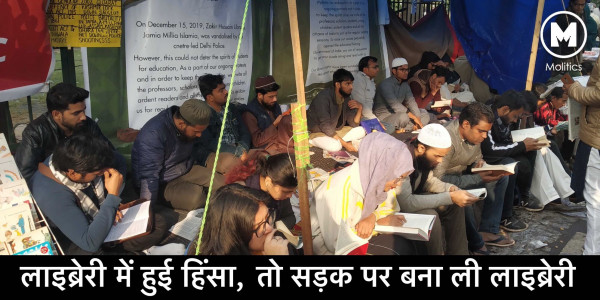
जामिया प्रोटेस्ट – पुलिस ने लाइब्रेरी में की हिंसा, हमने सड़क पर बना ली लाइब्रेरी!

“उन्होंने हमारी लाइब्रेरी में घुसकर हिंसा की, हमने सड़क पर लाइब्रेरी बना ली। आप कभी भी जाकर देखिए सड़क पर आंदोलन के बीच स्टूडेंट्स पढ़ते हुए दिख जाएंगे। वो हमें मार-पीट सकते हैं पर हमारे हौसले को नहीं तोड़ सकते। पढ़ाई और लड़ाई साथ साथ चलेगी।” – जामिया मिलिया इस्लामिया विश्वविद्यालय के गेट नंबर सात के सामने चल रहे आंदोलन के दौरान जामिया के एक छात्र ने यह बात कही।

जामिया मिलिया इस्लामिया विश्वविद्यालय परिसर में बच्चों के ऊपर बर्बर पुलिस अत्याचार की घटना को एक महीने से अधिक समय हो गया है। लेकिन इस घटना में न कोई एफआईआर लिखी गई है न ही कोई कार्रवाई हुई है। विवि प्रशासन के वरिष्ठ अधिकारी ने बताया कि प्रशासन की तमाम कोशिशों के बावजूद पुलिस ने FIR नहीं लिखी है।

विश्वविद्यालय प्रशासनकीकोशिशेंनाकाफी

जामिया कोर्डिनेशन कमेटी की सफूरा ने कहा कि FIR दर्ज़ कराने के लिए जितनी कोशिशें विश्वविद्यालय प्रशासन की कोशिशें नाकाफी थीं। उन्होंने कहा कि विश्वविद्यालय के वाइस चांसलर ने 17 तारीख़ को पुलिस के खिलाफ FIR दर्ज़ कराने को लेकर स्टूडेंट्स को आश्वस्त किया।

यह भी पढ़ें: CAB: हिंदू पाकिस्तान बनने की राह पर भारत!

बकौल सफूरा, वाइस चांसलर ने कहा कि पुलिस FIR दर्ज़ नहीं कर रही है। इस कारण से ई-मेल के ज़रिए भी शिकायत भेजी जाएगी और ऐसा न होने पर मजिस्ट्रेट के ज़रिए पुलिस के खिलाफ FIR दर्ज़ करवाई जाएगी। लेकिन 17 दिसंबर से 6 जनवरी तक इस संदर्भ भी कुछ भी ठोस नहीं हुआ।

विश्वविद्यालय प्रशासनखुदक्योंनहींआयाछात्रहितकेसमर्थनमें?

चलिए मान लेते हैं कि विवि प्रशासन की कोशिशों के बावजूद पुलिस ने जानबूझकर FIR नहीं लिखी। लेकिन फिर क्या विश्वविद्यालय प्रशासन की जिम्मेदारी नहीं बनती कि खुद आगे आकर स्टूडेंट्स से बातचीत करे और उन्हें स्थितियों से अवगत कराए। आखिर क्यों स्टूडेंट्स को सड़कों पर आकर आंदोलन करना पड़ता है? 

JCC के एक अन्य सदस्य श्रेयस कहते हैं कि 14 दिसंबर को हमला केवल छात्र-छात्राओं पर नहीं हुआ था बल्कि ये हमला पूरे विश्वविद्यालय पर हुआ। इसलिए होना ये चाहिए था कि प्रशासन खुद इस हमले के खिलाफ खड़ा होता।

परीक्षाओं कोक्योंखींचागयालंबा?

पुलिस की बर्बर कार्रवाई और जामिया कैम्पस में हिंसा के कारण यूनीवर्सिटी को 6 दिसंबर तक के लिए बंद कर दिया गया। नतीज़तन, छात्र-छात्राएँ परीक्षा नहीं दे पाए। 6 दिसंबर को जब विश्वविद्यालय खुला तो परीक्षा जल्द कराने की मांग की गई। विश्वविद्यालय प्रशासन ने परीक्षाओं को पुनर्निर्धारित किया। 

यह भी पढ़ें: ‘Hum Dekhenge’ controversy: Was Faiz Ahmed Faiz, Anti-Hindu?

JCC के एक सदस्य ने बताया कि जो परीक्षाएँ दस दिनों के अंदर खत्म हो सकतीं थीं, उन्हें जान-बूझकर लंबा खींचा गया है। प्रशासन की ओर से परीक्षाओं को लंबा खींचने की वजह बताई गई विवि परिसर में हिंसा के बाद पैदा हुई असामान्य स्थिति।

विवि प्रशासनऔरवाइसचांसलरक्योंनहींकरतेसंवाद?

लेकिन स्टूडेंट्स का कहना है कि इन असामान्य स्थितियों से निबटने के लिए बेहतर ये होता कि विवि प्रशासन से जुडे़ लोग स्टूडेंट्स तक पहुँचने की कोशिश करते। संवाद के माध्यमों को खुला रखते और चिंताओं को सुनकर उन्हें दूर करने की कोशिश करते।

यह भी पढ़ें: CAA Stir, How Citizens are resisting the controversial act

कुलपति की भूमिका के बारे में बोलते हुए सफूरा ने सवाल उठाया कि क्या इन स्थितियों में उन्हे छात्र-छात्राओं से सीधे संवाद स्थापित नहीं करना चाहिए? क्यों कुलपति की जगह अन्य प्रशासक उनके प्रवक्ता की तरह व्यवहार कर रहे हैं? 

विश्वविद्यालयकेफैसलोंमेंशामिलहोंगेस्टूडेंट्स!

खैर इन स्थितियों के बाद जामिया कोर्डिनेशन कमेटी विश्वविद्यालय के फैसलों में स्टूडेंट्स की सहभागिता की बात करती हैं। उन्हें लगता है कि स्टूडेंट्स का पक्ष जाने बिना उनके बारे में फैसला नहीं लिया जाना चाहिए। और उनके वाज़िब सवालों को एड्रेस किया जाना चाहिए।

यह भी पढ़ें: The CAA Narrative is a Watershed Moment for the judiciary not to falter

विश्वविद्यलय में हुई हिंसाओं के विरोध में बोलते हुए जामिया के एक छात्र सिराज ने बताया कि हिंसा और नफ़रत की आग सभी को जलाएगी। आज नहीं तो कल सभी की बारी आएगी। ये वक्त है करो या मरो का। संवैधानिक अधिकारों की रक्षा करना हम सभी का दायित्व है।

source : https://www.molitics.in/article/637/jamia-protests-what-students-want-from-administration

Is there a link between upcoming Delhi assembly polls and the Violence inside JNU?

Is there a link between upcoming Delhi assembly polls and the Violence inside JNU?

As the Delhi assembly elections are approaching nearer, politics has heated up in the national capital. The BJP, the Congress party, and the Aam Aadmi Party have all left behind the development issue and are busy doing politics over the Citizenship Amendment Act. This time just a month ahead of elections, the Delhi voters are talking nothing other than CAA, and this is what basically the political parties want, irrespective of their ideologies.

The common voter is thus falling into the trap of our political leaders. Besides, our politicians know how to play with the mind of youths, especially those studying in premier educational institutions.

When it comes to student politics, JNU’s name comes on the top. The University is often called an ‘adda’ (hub) of politics. A few days back there was an outrage among the students over the fee hike issue. Whether the fee-hike issue was justified or not is another debate. However, the panic created by those, who were really not worried about the hike but wanted to fulfill their own vested interests, gathered a lot of media coverage. The issue was indeed, blown out of proportion.

Similarly, in 2016, Jawaharlal Nehru University was in news over the ‘Tukde-Tukde controversy.’ On February 9, 2016, the university turned into a battleground, after a group of students organised an event to mark the death anniversaries of Parliament attack accused, Afzal Guru and the co-founder of Jammu Kashmir Liberation Front (JKLF), Maqbool Bhat. Surprisingly, the commemorative meeting went ahead even after the JNU administration revoked permission for the programme in the wake of complaints from Akhil Bharatiya Vidyarthi Parishad (ABVP).

After clashes erupted between the ABVP and the JNUSU, sedition charges were slapped on Anirban Bhattacharya, Umar Khalid and Kanhaiya Kumar, the organisers of the event. Khalid and Bhattacharya were among the five students who, along with JNU Students’ Union (JNUSU) president Kanhaiya Kumar, had allegedly shouted anti-national slogans at the event.

The February 9, incident was a widely debated issue in that year, there were demands to shut down JNU. What aggravated the situation further were the visits of our political leaders like Rahul Gandhi, former Union ministers Anand Sharma and Ajay Maken, former Rajya Sabha member D. Raja and Swaraj Abhiyan chief Yogendra Yadav, to the JNU campus.

No doubt, these political leaders visited the campus for their selfish interests and none of them cared about the future of students studying in JNU. As political representatives, our duty is to guide the students to follow a right path, however, seeking political mileage by turning educational institutions into political battlefields is nothing but dirty politics.

Read more: How civil society, opposition & students responded to the CAA

This time, when protests around CAA have already created a tensed environment in the national capital, what happened in JNU, yesterday, is highly condemnable. On Sunday night, a mob of around 50 to 60 masked men and women, holding sticks and rods entered hostel buildings, and allegedly assaulted students and vandalized the campus.

As the blame game between the ABVP and the left-wing over the violence continues, the question remains as to if our educational institutions safe, do they ensure the safety of students to their parents who send their children so as to get quality education in these prestigious institutions? The recent incident raises a big question mark on the security arrangements. Why couldn’t the security guards identify these masked assailants when they entered the University campus?

Read more: The CAA Narrative is a Watershed Moment for the judiciary not to falter

That too, when it’s an established fact that JNU is a hub of political activities and situation in Delhi was already boiling following the ongoing anti-CAA protests. Political gimmick around the whole JNU episode cannot be ruled out. Whether those who attacked the students and teachers belonged to ABVP gang or the JNUSU gang is not important, what is crucial is that our leaders should not politicise the issue as they are doing now. A time bound probe should be ordered into this whole incident and those found guilty should be punished.

Educational institutions are basically meant to seek knowledge and they should not be turned into violence sites. Student politics is good, but only as long as, it is within its limits.

Besides, Neither the ABVP gang should dominate campus life in India in the name of nationalism, nor should those affiliated with the left-wing group try to make any attempt to portray a terrorist as a hero. By commemorating Afzal Guru in JNU, the students belonging to the left-wing group did an insult to the family member of those who laid down their lives in the 2001 Indian parliament attack.

Read more: Congress Seva Dal’s article on Veer Savarkar sparks fresh row

It is least expected from those studying in one of India’s most prestigious institutions, to differentiate between a martyr and a terrorist. After all, a terrorist is a terrorist and a martyr is a martyr. In the same year, reacting to the JNU controversy, ace wrestler Yogeshwar Dutt had written a patriotic poem in Hindi. A translation of few lines, from the poem goes like this:

“They consider themselves as enemies of the country in which they are born.

What sort of freedom of speech is this that permits one to abuse Mother India.

What sort of freedom of expression allows one to violate the honor of my country?

If Afzal is martyr then who is Hanamanthappa?”

source: https://molitics.in/article/633/Is-there-a-link-between-upcoming-delhi-assembly-polls-and-the-violence-inside-jnu

The CAA Narrative is a Watershed Moment for the judiciary not to falter

The CAA Narrative is a Watershed Moment for the judiciary not to falter

The recent enactment of the amendments to the Citizenship Act of 1955 has left many very disturbed.  
The legislation itself is undoubtedly problematic and is when compounded by the linkages with the National Register of Citizens (NRC), creates a sense of fear in a particular community. 

The CAA is touted as a “fast-track” means of granting citizenship by naturalization to what it identifies as persecuted minorities (Hindus, Sikhs, Buddhists, Jains, Parsis, and Christians) from three neighboring countries (Afghanistan, Bangladesh, and Pakistan). Those belonging to these communities from these countries will not, as per the law, be regarded as “illegal immigrants”.

It is arbitrary and violates the right to equality before law enshrined in Article 14 of the Indian Constitution. It deliberately marginalizes Muslims as a minority community and uses religious identity as the basis for granting citizenship 
 
The protests that have followed the Citizenship (Amendment) Act (CAA), 2019, were not surprising, but how the protesters were treated certainly is. The nation is continuously witnessing hundreds of protests in many cities. Most of them are peaceful like in Shaheen Bagh, Jantar Mantar, Jama Masjid, Police Headquarters Delhi, and in many cities of India.  

Also read: Can we have a corruption-free society?


These protests mainly started from the universities like Jamia Milia Islamia and Aligarh Muslim university but the way how the police tried to suppress the protests by brutally hurting the students in their campuses, by opening fire on them in university, sparked the anger among the whole student community across the nation. The students of various universities like JNU, DU, PU, BHU, IITs, IIMs, and many Indian students studying in different parts of the world also stood in solidarity with these students and protested in their capacity.

Many of them refused to receive their gold medals, their degree during the convocation ceremony in the presence of the dignitaries. 
  
Police Actions Under Question 
 
The reaction of the law and order machinery to what were essentially student-led peaceful protests has led to incidents of violence and loss of property across the country, which is unfortunate. The way in which UP police was seen misbehaving and abusing members of a specific community is condemnable and raised serious questions on the working of police.  

Also read: Why is there an uproar over Citizenship Amendment Bill


Were they having the support of their political masters when they were targeting the peoples of Muslim community? The way in which the Firozabad administration sends notice to the person who died 6 years ago for causing violence during Anti-CAA protests, raises doubts. Does the police arrest the suspects by identifying them by their clothes? 
 
Expectations From The Judiciary 
 
The Judiciary should immediately step in and start hearing the petitions filed by many social activists to evaluate and infer upon the situation. In the wake of the CAA protests, the Chief Justice of India reportedly said that if people/protesters wanted to “take to the streets”, then they need not approach the courts.

Some could read this statement as a sort of warning that good behavior was a prerequisite for obtaining justice. In any event, in a democracy, protest and recourse to the judiciary are options that are legitimately available to the people. Dissent or protest is the lifeline of a democracy. But, what is the judiciary supposed to do when society as a whole is protesting? In such a scenario, there is no clear line that can be drawn between declaring protesters as good or bad. 
This is a watershed moment for this generation of judges.

Shame of the week | Ajit Bharti | OpIndia | Ravish Kumar | NDTV | Molitics

अपने आप को पत्रकार कहने वाले अजीत भारती ने अपने ऑपइंडिया नाम के चैनल से पूरी पत्रकारिता को ही शर्मसार कर दिया है। न सरकार न विपक्ष बल्कि उनका एक पूरा शो पत्रकार रवीश कुमार के खिलाफ चलता है।

source: https://www.molitics.in/news/139447/Shame-of-the-week-molitics-news

7 years down the line, we find out as to how effectively the Govt has dealt with the women safety issue

Seven years have passed, however, Nirbhaya is still awaiting justice. On the intervening night of December 16-17, a 23-year-old paramedic student who came to be known as Nirbhaya, was gang-raped inside a running bus in south Delhi by six people and was later thrown out on the road. The deceased later succumbed to her injuries. Asha devi, the mother of the victim, has yet again on Monday, appealed the government and judiciary to hang the four convicts. Whenever, this day, December 16 arrives, one question which probably hits all of us, is, whether anything related to women safety has really changed in our country, or the situation is still the same?

Nirbhaya incident and other such instances of brutal rape have given India the dismal reputation of being one of the worst places in the world to be female. To answer the question if India has become safer for women in all these years, the statistics present a bleak picture. Statistics, bear out the stark reality faced by women in India, a country where feminine form is worshipped as the mother Goddess.  


Nirbhaya case sparked widespread public protests and soon there were demands to award death penalty to those involved in the heinous crime. The horrific incident shook the entire nation and the Indian govt. realized that time has come to take stringent measures and bring in new laws to effectively deal with the rape issue.

Can we have a corruption free society?

Protests, candle march were carried out in the national capital post-Nirbhaya in protest against the rise in rape cases. In order to placate the angry public the govt announced a host of measures like setting up of fast track trial courts, women helpline number, Nirbhaya fund and one stop center scheme.  
 
The horrific gangrape and murder of a 26-year-old woman veterinarian in Telangana indicate that women are as unsafe and fearful today as they were on the eve of Nirbhaya gangrape and murder case. 

Nirbhaya fund and its utilisation 


Nirbhaya Fund was created in 2013 in the aftermonth of December 2012 Delhi gangrape and murder case. Giving in to popular sentiments, the government announced a separate fund for meeting expenditures to ensure safety of women. The govt proposed an allocation of Rs 10,000 crore under Nirbhaya Fund to ensure safety of women. However, hardly any woman can today claim that Nirbhaya Fund has made her fearless.


According to the latest data, presented in Parliament by Women and Child Development Minister Smriti Irani – in the wake of questions raised over safety and security of women following the Hyderabad gangrape and murder case – the ministry has allocated Rs 2,050 crore to various states from the Nirbhaya Fund. 


The Union home ministry on its part has released Rs 1,656 crore in the last five years to states and Union Territories. But utilisation rate of Nirbhaya Fund has been very dismal. 


For the funds released by the Union Women and Child Development Ministry, only about 20 % has been used by the states. In the case of Union home ministry, the states have submitted utilisation certificates of less than 9 per cent money released under Nirbhaya Fund. 
Six states and UTs – Maharashtra, Manipur, Meghalaya, Sikkim, Tripura and Daman & Diu – have not spent a single rupee from the Nirbhaya Fund allocated by the Union home ministry. 

Why is there an uproar over Citizenship Amendment Bill?


Big state like Maharashtra had been under the BJP rule for five years, from 2014 to 2019. Yet the BJP-led govt of the Centre could not put enough pressure on Maharashtra, which recorded 4,306 incidents of assault on women in 2017.  
 
ONE STOP CENTRE SCHEME  


Launched in 2015, it provides integrated support and assistance under one roof to women affected by violence. Not fully operational in all states. 


DIAL 112  


This pan-India phone number (like 911 in the US) was launched in 2019, under the Emergency Response Support System, aimed at improving women’s safety. It is not functional in several states. 
 
Death penalty: Will it really deter rape 


Given the current context, People from all corner of the nation are demanding a death penalty for rapists. This remains a highly debatable issue between those who advocate death penalty and for those who are against capital punishment. Death penalty violates Article 21, i..e Right to life and as such this cannot be done, if we go by the logical argument.  

Onion price likely to fall over next few days


No studies prove that awarding death penalty to rapists will in anyway deter them from committing such acts. The problem lies somewhere else, probably in our justice delivery system. It is right said, that justice delayed is justice denied. 


A report, submitted in 2017, pointed out that the average time of finishing trial in rape cases was eight months in the fast-track courts. Not all rape cases in India are tried in fast-track courts. 
The study also found that in most cases, even the deposition of the rape victim does not take place within 60 days. The fast tracked Nirbhaya gangrape case was disposed in nine months. 
Delay in trial of rape cases occur due to various reasons – from receiving forensic lab reports to huge burden of pending cases. 

Constitution and Democracy! Are we really following the boundaries?

 
What can be the possible solutions- 
The real issue appears to be the time taken in the final disposal of cases of rape and murder. What is required for any law to act as a real deterrent is bringing about long pending police and judicial reforms.   


Over 32,500 cases of rape were registered with the police in 2017, about 90 a day, according to the most recent government data. Laws become ineffective in the absence of adequate support from its many arms. Police often face allegations of insensitivity while handling rape cases. Once the case reaches the courts, they drag on and on. NCRB data also show that conviction rate in rape cases is just 32 per cent, which is attributed mainly to delay in completion of trials. Regardless of the crime, understaffing is a major driver of pendency in both courts and police forces.  

CAA Stir, How Citizens are resisting the controversial act


Moreover, Indian courts disposed of only about 18,300 cases related to rape that year, leaving more than 127,800 cases pending at the end of 2017. Nevertheless, this week, as a debate raged in Parliament over the Hyderabad case, Rajya Sabha speaker and Vice President M. Venkaiah Naidu said: “What is required is political will, administrative skill, change of mindset and then go for the kill of social evil.”

source: https://www.molitics.in/article/619/7-years-down-t

Seven years have passed, however, Nirbhaya is still awaiting justice. On the intervening night of December 16-17, a 23-year-old paramedic student who came to be known as Nirbhaya, was gang-raped inside a running bus in south Delhi by six people and was later thrown out on the road. The deceased later succumbed to her injuries. Asha devi, the mother of the victim, has yet again on Monday, appealed the government and judiciary to hang the four convicts. Whenever, this day, December 16 arrives, one question which probably hits all of us, is, whether anything related to women safety has really changed in our country, or the situation is still the same?

Nirbhaya incident and other such instances of brutal rape have given India the dismal reputation of being one of the worst places in the world to be female. To answer the question if India has become safer for women in all these years, the statistics present a bleak picture. Statistics, bear out the stark reality faced by women in India, a country where feminine form is worshipped as the mother Goddess.  


Nirbhaya case sparked widespread public protests and soon there were demands to award death penalty to those involved in the heinous crime. The horrific incident shook the entire nation and the Indian govt. realized that time has come to take stringent measures and bring in new laws to effectively deal with the rape issue.

Can we have a corruption free society?

Protests, candle march were carried out in the national capital post-Nirbhaya in protest against the rise in rape cases. In order to placate the angry public the govt announced a host of measures like setting up of fast track trial courts, women helpline number, Nirbhaya fund and one stop center scheme.  
 
The horrific gangrape and murder of a 26-year-old woman veterinarian in Telangana indicate that women are as unsafe and fearful today as they were on the eve of Nirbhaya gangrape and murder case. 

Nirbhaya fund and its utilisation 


Nirbhaya Fund was created in 2013 in the aftermonth of December 2012 Delhi gangrape and murder case. Giving in to popular sentiments, the government announced a separate fund for meeting expenditures to ensure safety of women. The govt proposed an allocation of Rs 10,000 crore under Nirbhaya Fund to ensure safety of women. However, hardly any woman can today claim that Nirbhaya Fund has made her fearless.


According to the latest data, presented in Parliament by Women and Child Development Minister Smriti Irani – in the wake of questions raised over safety and security of women following the Hyderabad gangrape and murder case – the ministry has allocated Rs 2,050 crore to various states from the Nirbhaya Fund. 


The Union home ministry on its part has released Rs 1,656 crore in the last five years to states and Union Territories. But utilisation rate of Nirbhaya Fund has been very dismal. 


For the funds released by the Union Women and Child Development Ministry, only about 20 % has been used by the states. In the case of Union home ministry, the states have submitted utilisation certificates of less than 9 per cent money released under Nirbhaya Fund. 
Six states and UTs – Maharashtra, Manipur, Meghalaya, Sikkim, Tripura and Daman & Diu – have not spent a single rupee from the Nirbhaya Fund allocated by the Union home ministry. 

Why is there an uproar over Citizenship Amendment Bill?


Big state like Maharashtra had been under the BJP rule for five years, from 2014 to 2019. Yet the BJP-led govt of the Centre could not put enough pressure on Maharashtra, which recorded 4,306 incidents of assault on women in 2017.  
 
ONE STOP CENTRE SCHEME  


Launched in 2015, it provides integrated support and assistance under one roof to women affected by violence. Not fully operational in all states. 


DIAL 112  


This pan-India phone number (like 911 in the US) was launched in 2019, under the Emergency Response Support System, aimed at improving women’s safety. It is not functional in several states. 
 
Death penalty: Will it really deter rape 


Given the current context, People from all corner of the nation are demanding a death penalty for rapists. This remains a highly debatable issue between those who advocate death penalty and for those who are against capital punishment. Death penalty violates Article 21, i..e Right to life and as such this cannot be done, if we go by the logical argument.  

Onion price likely to fall over next few days


No studies prove that awarding death penalty to rapists will in anyway deter them from committing such acts. The problem lies somewhere else, probably in our justice delivery system. It is right said, that justice delayed is justice denied. 


A report, submitted in 2017, pointed out that the average time of finishing trial in rape cases was eight months in the fast-track courts. Not all rape cases in India are tried in fast-track courts. 
The study also found that in most cases, even the deposition of the rape victim does not take place within 60 days. The fast tracked Nirbhaya gangrape case was disposed in nine months. 
Delay in trial of rape cases occur due to various reasons – from receiving forensic lab reports to huge burden of pending cases. 

Constitution and Democracy! Are we really following the boundaries?

 
What can be the possible solutions- 
The real issue appears to be the time taken in the final disposal of cases of rape and murder. What is required for any law to act as a real deterrent is bringing about long pending police and judicial reforms.   


Over 32,500 cases of rape were registered with the police in 2017, about 90 a day, according to the most recent government data. Laws become ineffective in the absence of adequate support from its many arms. Police often face allegations of insensitivity while handling rape cases. Once the case reaches the courts, they drag on and on. NCRB data also show that conviction rate in rape cases is just 32 per cent, which is attributed mainly to delay in completion of trials. Regardless of the crime, understaffing is a major driver of pendency in both courts and police forces.  

CAA Stir, How Citizens are resisting the controversial act


Moreover, Indian courts disposed of only about 18,300 cases related to rape that year, leaving more than 127,800 cases pending at the end of 2017. Nevertheless, this week, as a debate raged in Parliament over the Hyderabad case, Rajya Sabha speaker and Vice President M. Venkaiah Naidu said: “What is required is political will, administrative skill, change of mindset and then go for the kill of social evil.”

source: https://www.molitics.in/article/619/7-years-down-the-line-delhi-rape-case-women-safety-issue

he-line-delhi-rape-case-women-safety-issue

Shame of the Week | No Ambulance to Vashishtha Narayan, UP homeguards forced to beg | Molitics

No Ambulance for Vashishtha Narayan after his death, UP home guards forced to beg, Run for children in presence of pollution – Social Media पर एक बार फिर कई शर्मनाक घटनाएं सामने आई है. Shame of the week में हम बता रहे हैं वो घटनाएँ।

#airpollution #vashistnarayansingh #uphomeguard

source: https://www.molitics.in/news/137246/Shame-of-the-Week

Install Molitics Android App: https://molitics.app.link/1veztabf8W

Like Molitics on Facebook: https://www.facebook.com/Molitics/

Follow Molitics on Twitter: https://twitter.com/moliticsindia

Santosh Gangwar remarks about employment is to command youth

संतोष गंगवार ने क्यों कहा कि रोज़गार के अवसरों की नहीं बल्कि उत्तर भारतीयों में योग्यता की कमी!

संतोष गंगवार साहब ने कहा है कि नौकरियों की कमी नहीं है बल्कि उत्तर भारतीयों में योग्यता की कमी है। उनका यह बयान शासन चलाए रखने की प्रैक्टिस का एक हिस्सा मात्र है। दरअसल, ऐसा कहकर वो न केवल रोज़गार के मोर्चे पर विफल अपनी सरकार को बचाने की कोशिश कर रहे हैं बल्कि बेरोज़गार युवाओं में सेंस ऑफ इनफीरियरटी (हीनता का भाव) भी विकसित करना चाहते हैं। एक बार यह सेंस (भाव) विकसित हो जाए तो सवाल खत्म हो जाते हैं। और सवाल खत्म तो शासन आसान।

कमांड करने के लिए सेंस ऑफ इनफीरियरटी विकसित कराना ज़रूरी

समाज में भगवान को लेकर भी यही सेंस डिवेलप कराया जाता है। इस सेंस ऑफ इनफीरियरटी से सेंस ऑफ इनसिक्योरिटी विकसित होती है औऱ यहीं उस आधार का निर्माण होता है, जो समूह विशेष पर कमांड करने के लिए ज़रूरी है।

बचपन से ही इस प्रक्रिया को महसूस किया जा सकता है। बेटा…वहाँ मत जाओ..वहाँ भूत है…बाहर मत जाओ…बाहर बाबा लोगो बच्चा उठा के ले जाते हैं। – इस तरह की बातों से बच्चों में असुरक्षा की भावना डाली जाती है। और इसके बाद उन्हें कमांड किया जाना शुरू हो जाता है।

महाराष्ट्र सरकार ने ‘अवनी’ कि जबरन हत्या की ?

ये तो है परिवार की बात। अब देखिए…उन दलों को जो दलितों की राजनीति करते हैं। ये दल दलितों के मन में पहले ये डर पैदा करते हैं कि तुम असुरक्षित हो…तमाम लोगो तुम्हारे खिलाफ हैं…देश की सामाजिक-राजनैतिक संरचना तुम्हारे खिलाफ है। इस असुरक्षा के भाव के बोध के बाद कमांड किया जाना शुरू होता है। मुस्लिमों औऱ हिंदुओं की राजनीति करने वाले भी यही करते हैं।

सवर्ण हिंदू वोटर्स बीजेपी के नियंत्रण में, बेरोज़गार युवा हैं ख़तरा

अब अगर मौजूदा सरकार की बात करें, तो जाति औऱ धर्म के स्तर पर यह लोगों को आराम से कमांड कर रही है। सवर्ण हिंदु वोटबैंक सरकार से चिपकी हुई है। और निकट भविष्य में सरकार के खिलाफ अगर कोई समूह खड़ा दिखाई देता है तो वह है रोज़गार की तलाश में लगे युवा। 2014 में मोदी सरकार रोज़गार सृजन के बड़े-बड़े वायदों के साथ सत्ता में आई थी। लेकिन सत्ता में आने के बाद रोज़गार प्रदान कर पाना तो दूर, सरकार रोज़गार बचा कर भी नहीं रख सकी। 

‘चरित्र’ की कमजोर भाजपा, ‘लक्ष्य की मजबूत’ है !

बेरोज़गारी पर लोग हो रहे हैं एकजुट

कई आँकड़ों ने ये साबित किया कि बेरोज़गारी रिकॉर्ड स्तर तक बढ़ चुकी है। स्वराज इंडिया के युवा हल्लाबोल और कई स्वतंत्र पत्रकारों ने इस मुद्दे को ज़ोरों-शोरों से उठाया जिसके कारण सरकार इस मोर्चे पर बैकफुट पर आ गई थी। 

उत्तर भारतीयों पर टिप्पणी का ये है कारण

ये समझना भी ज़रूरी है कि संतोष गंगवार ने उत्तर भारतीयों को लेकर ये टिप्पणी क्यों की! इसकी वजह है चुनावों में उत्तर भारत में बीजेपी का शानदार प्रदर्शन। मुख्यतया हिंदी पट्टी का निर्माण करती है। और यह हिंदी पट्टी बीजेपी की ताकत है। इस पट्टी के लोगों के नाराज़ हो जाने का मतलब पार्टी और सरकार को गंभीर नुकसान है। 

आखिर संसद तक कैसे पहुंच जाते हैं आरोपी ?

इसीलिए इस क्षेत्र में जो तबका नाराज़ हो सकता है, उस तबके को नियंत्रण में लिया जाना ज़रूरी है। और संतोष गंगवार ने नियंत्रण में लेने के पारंपरिक तरीके को अपनाते हुए युवाओं में हीनता के भाव विकसित करने की कोशिश की है। 

इसे भी पढ़ें: मोदी सरकार युवाओ को रोजगार देने में असमर्थ रही हैं।

source:https://www.molitics.in/article/597/santosh-gangwar-remarks-about-employment-is-to-command-youth

Tashkent files ke baad yavatmal files kyo nahi

महाराष्ट्र सरकार ने ‘अवनी’ कि जबरन हत्या की ?

अवनी बाघिन थी. यवतमाल के एक जंगल में रहती थी. अब बाघिन थी, तो जायज है शिकार करेगी ही. लेकिन उसे रिहायशी इलाकों में कभी नहीं देखा गया. जंगल में अपने शावकों के साथ रहती थी. उस पर ‘आदमखोर’ का तमगा मढ़ा गया. उसे पकड़ कर कहीं और ले जाया जा सकता था. लेकिन उसे मरना उचित समझा गया. क्योंकि वो सिर्फ ‘आदमखोर’ नहीं थी. वो रोड़ा बन चुकी थी किसी कॉन्ट्रैक्ट की, शायद इसलिए उसे मारा गया ?

3 नवंबर 2018 को खबर आयी की यवतमाल में पंधरकावड़ा जंगल के आसपास रहने वाले लोगों की नींद हराम कर चुकी नरभक्षी बाघिन अवनि को मार दिया गया है. अवनि ने 14 इंसानों को अपना शिकार बनाया था. महाराष्ट्र सरकार ने अवनि को मारने के लिए ‘शूट-एट-साइट’ का आदेश दिया था.

यहाँ भी देखें:  कनैक्टिंग इंडिया वाली BSNL आखिर क्यों टूट रही है?
 

‘अवनी ‘आदमख़ोर’ नहीं थी’

अवनी की मौत को लेकर कहानी गढ़ी गई है. उनका आरोप है कि सरकार अवनी को मारना ही चाहती थी जिसके लिए पहले बाघिन को ‘आदमख़ोर’ घोषित किया गया और बाद में उसे मारने के पीछे ‘परिस्थितियों’ को वजह बताया गया. अवनी आदमख़ोर नहीं थी और वन विभाग के पास इस बात के ठोस सबूत नहीं हैं कि 13 लोगों की मौतों के लिए वही ज़िम्मेदार थी.

यहाँ भी देखें : सरपंच की तानाशाही खा गयी गांव की सड़क

टाइम्स ऑफ़ इंडिया ने भी अपनी एक रिपोर्ट में विशेषज्ञों के हवाले से बताया है कि परीक्षण के बाद यह साबित नहीं हो सका कि अवनी के हमले से ही इन लोगों की मौत हुई. वहीं वन विभाग के अधिकारी से वार्ता के दौरान पता चला की अगर बाघ जंगल में घुसे इंसानों का शिकार करता है, तो उसे आदमख़ोर नहीं कहा जा सकता.

अवनी को मारने में नियमों का ‘उल्लंघन’ हुआ

रिपोर्टों के मुताबिक़ सुप्रीम कोर्ट का निर्देश था कि मारने से पहले अवनी को बेहोश करने वाला इंजेक्शन दिया जाए. सर्वोच्च अदालत का यह भी निर्देश था कि पहले बाघिन को पकड़ा जाए और फिर गोली मारी जाए. लेकिन उसके पहले बाघिन अवनी के दस महीने के दोनों बच्चों को क़ब्जे में लिया जाए, क्योंकि अवनी की मौत के बाद उनका जंगल में जी पाना संभव नहीं होगा. लेकिन ऐसा नहीं हुआ

यहाँ भी देखें : Do we all need Modi’s ‘FIT’ Pill?

जेरिल ए बनाइट वन्य जीवन पर काम करने वाले कार्यकर्ता हैं. अवनी के मामले में उन्होंने सुप्रीम कोर्ट में जनहित याचिका दायर की थी. जेरिल का दावा है कि अवनी को मारने में राष्ट्रीय बाघ संरक्षण प्राधिकरण (एनटीसीए) के नियमों का घोर उल्लंघन हुआ है. जेरिल कहते हैं, ‘पहली बात तो यही है कि इस तरह के अभियान केवल उजाले में चलाए जाते हैं. वहीं एनटीसीए के नियमों के विपरीत अवनी की हत्या के समय कोई पशुचिकित्सक मौके पर मौजूद नहीं था, न ही वहां पुलिस थी. अवनी जैसे किसी विशेष बाघ की बात छोड़ भी दें, तो इतनी रात में किसी बाघ की लैंगिक पहचान भी मुश्किल है.’Read more

Do we all need Modi’s ‘FIT’ Pill?

There is an old saying “A sound mind lives in a sound body” and so our Prime minister is all set to practice it.

Thursday, 29 August PM Narendra Modi live addressed the whole country and inaugurated the ‘FIT India Movement 2019’ on the occasion of National Sports Day and the birth ceremony of great sports person Dhyan Chand. With a tribute to him, the ceremony had a grand opening including a FIT India pledge and a presentation including great Indian history of martial arts, dance, and sports. Modi said,” technology contributed to a sedentary lifestyle and one should work on his/her body and mental peace”.

Phases of Indo-Pak conflict over Kashmir Issue !!!

Glimpse of India Pakistan partition in 1947 are still showing its aftereffects till date. At the time of division when 3 princely states-Junagarh, Hyderabad and J&K were disputed; Vallabh Bhai patel with his smartness was able to add Junagarh and Hyderabad in India. Whereas Hari Singh, that time J&K Ruler, kept it as an independent state. Later pakistan attacked Hari Singh’s state and occupied a part of kashmir, at that time Hari Singh raised his consent to merge with India and with International validation J&K became part of India. But due to the disputes J&k was accorded a special status under Article 370